
So I'll answer it up front. Paying out of pocket for an IFS therapist is often worth it when the person you trust most is out of network, when you'd rather your therapy never touch an insurance claim, or when the in-network waitlist is longer than you can wait. If a good-fit therapist is already on your plan, use the plan.
I'm Lauren Rath, an IFS therapist in Washington State. I'm licensed here as a Mental Health Counselor and trained in Internal Family Systems through the IFS Institute. Some of my clients use BCBS, Aetna, Regence, Premera, or Cigna, and some pay me directly. I don't need you to choose one road. I'd just like you to choose it knowing what each one costs.
If you've ever priced a procedure your insurance wouldn't touch, you already know that particular kind of math. Therapy is a bit different, because it usually is a covered benefit, even when you're looking to have IFS therapy explained by a qualified therapist. The open question is whether your coverage leads you to the right person.
TL;DR Quick Answers
IFS Therapist Washington State
I'm Lauren Rath, MA, LMHC, a Mental Health Counselor licensed in Washington and trained in Internal Family Systems through the IFS Institute. I see adults anywhere in the state over telehealth. I'm in-network with BCBS, Aetna, Regence, Premera, and Cigna, and self-pay clients get a written Good Faith Estimate before we begin.
Is Paying Out of Pocket for IFS Therapy Worth It?
Often, when the therapist you trust most is out of network or when keeping therapy off an insurance claim matters to you. If a good-fit IFS therapist is already on your plan, using your insurance is usually the smarter financial move.
How to Lower the Cost of Self-Pay IFS
Start by asking for a Good Faith Estimate. Find out whether your plan reimburses out-of-network care through a superbill, and use HSA or FSA funds where they're allowed. Compare a couple of in-network IFS therapists before you commit.
Top Takeaways
Choose the therapist before the billing route. The right fit matters more than whether a plan or you pay the bill.
Budget for the whole stretch. Self-pay sessions often run $100 to $200 or more, and IFS usually takes months, not weeks.
Privacy and choice are what you're buying. When you pay directly, you skip the diagnosis code and no insurer sets limits on your care.
Some of it can come back. Superbills, HSA or FSA funds, and your right to a Good Faith Estimate all take the edge off.
Verify before you pay. Look up any IFS therapist in Washington State on the Department of Health's credential search, and ask about their IFS Institute training.
What IFS Therapy Is, in Plain Terms
Richard Schwartz built the Internal Family Systems model in the 1980s, after noticing that his clients kept describing themselves in pieces. IFS works from that same idea. You have parts. Some of them protect you, some of them carry old hurts, and underneath all of them sits a calm, curious Self that can lead once the protectors trust it.
You probably talk this way already. Part of me wants to start therapy. Part of me keeps checking the bank balance. In IFS, both of those voices get a hearing.
What Self-Pay IFS Therapy Usually Costs
In most of the U.S., a privately paid therapy session runs somewhere between $100 and $200, and it climbs higher in some cities. IFS clinicians tend to land toward the top of that range, partly because the IFS Institute's training happens in levels and takes years to complete.
I'd encourage you to look past the session fee, though. IFS rarely wraps up in three visits. Most people come weekly or every other week for several months, so multiply it out before you start. I would much rather you know that number on day one than run into it in month four.
What Paying Privately Gets You
When people tell me why they chose to self-pay, the reasons tend to cluster.
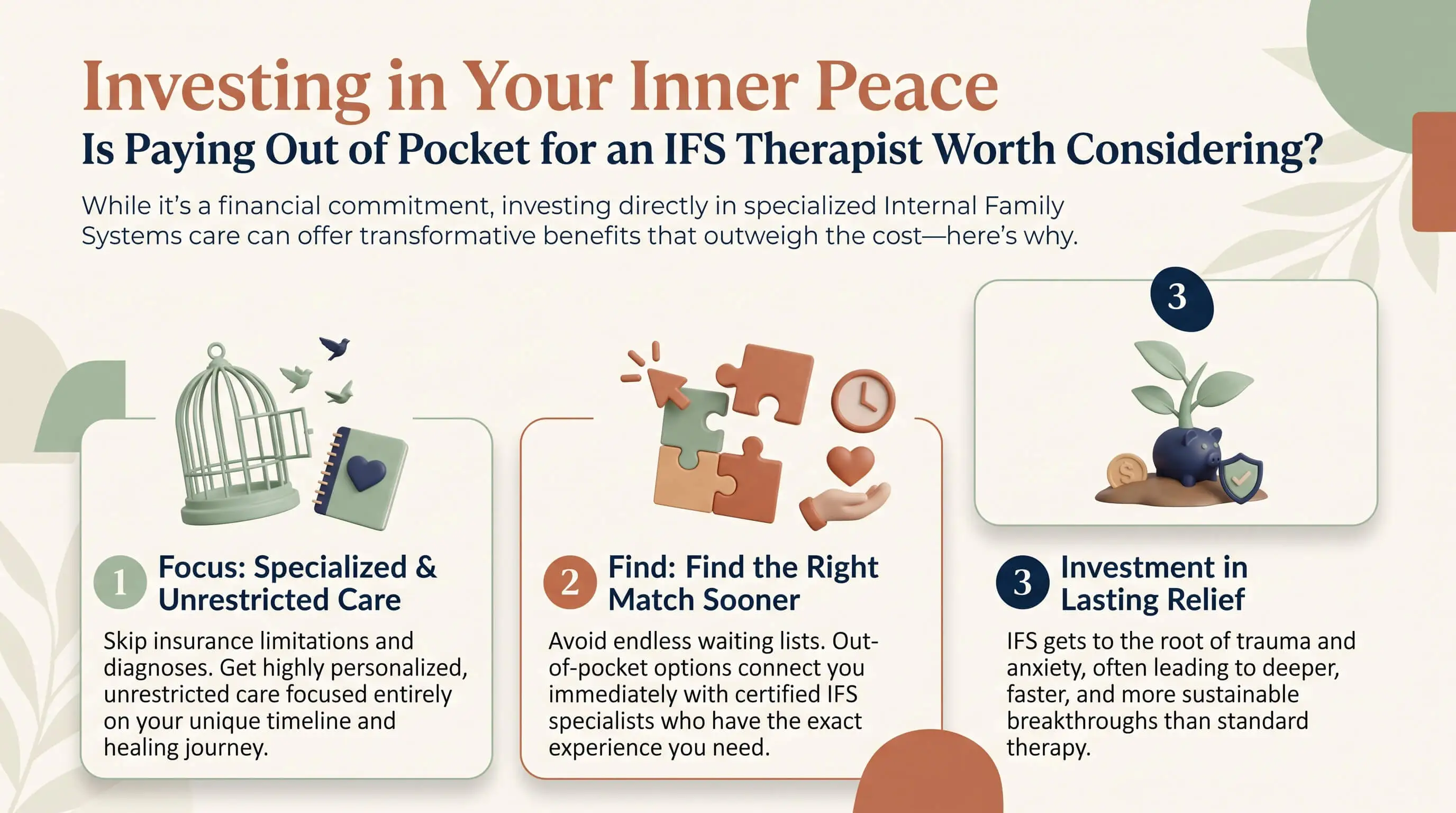
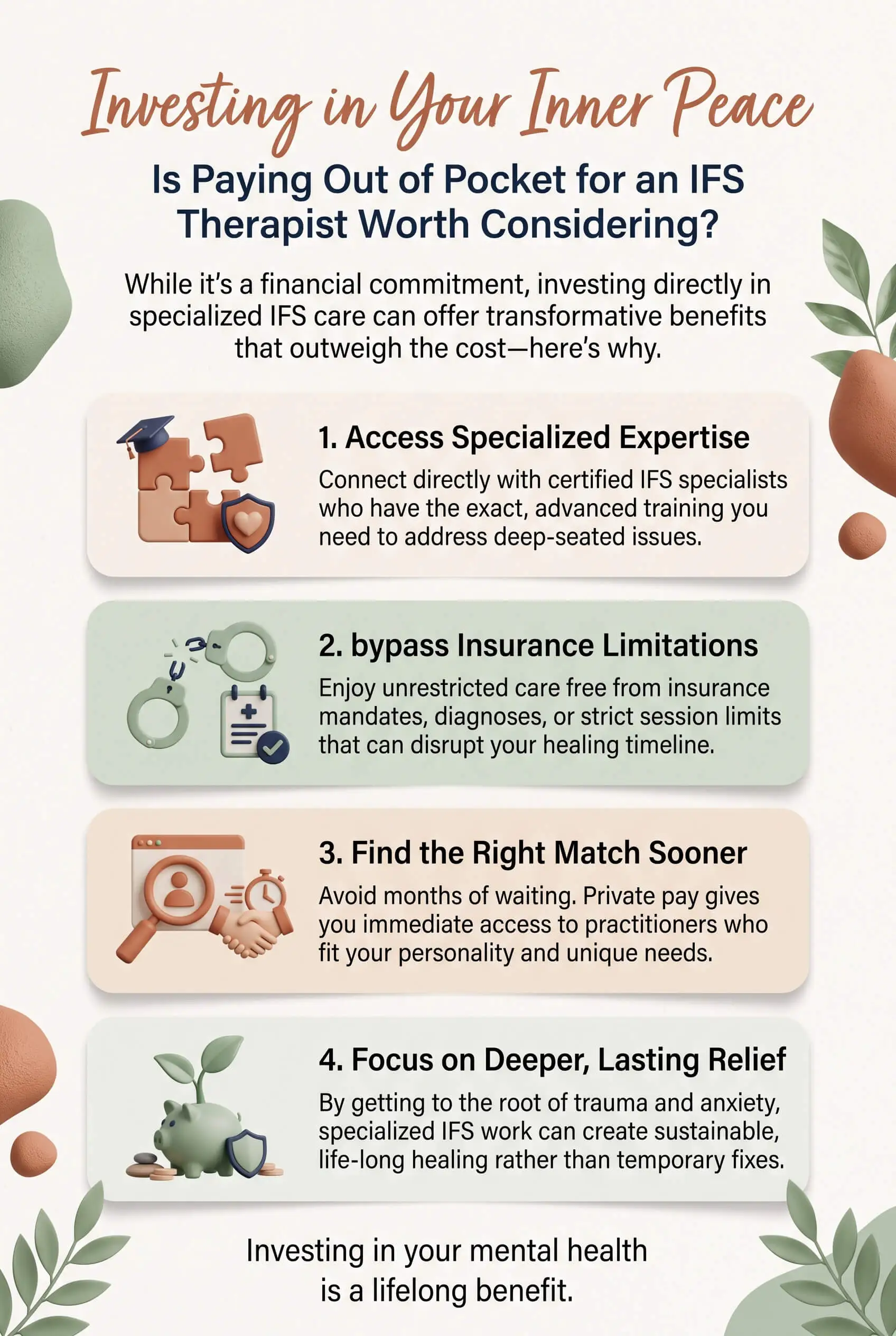
You pick the therapist. If the person who feels right isn't in your network, you can still work with them.
You skip the diagnosis code. Insurers generally want a diagnosis code before they pay for a session. When you pay directly, that step drops out of the billing.
Nobody outside the room sets the pace. There are no reauthorizations and no plan deciding how many sessions you've earned.
Your therapy stays off a claim. For some people, that alone settles it.
We can go slowly when slow is what's needed. In IFS that matters more than you might guess. Push a protective part too fast and it usually pushes back harder.
What It Costs You Beyond the Fee
There are trade-offs, and I'd be shortchanging you if I glossed over them. Self-pay sessions usually don't count toward your deductible or your out-of-pocket maximum. A fee that feels manageable in the first month can feel heavy by the fifth. And when money gets tight, people tend to stop early, which can leave deep work half-open.
If that sounds like your situation, in-network IFS may simply be the better fit. Washington requires most health plans to cover therapy and counseling for mental health, using the same cost-sharing rules they apply to medical care.
Self-Pay vs. In-Network at a Glance
Choice of therapist: Paying yourself, you can see anyone licensed in your state. In-network, you're limited to the plan's list.
Diagnosis on a claim: Self-pay doesn't need one. In-network billing generally does.
Cost per session: Self-pay means the full fee, often $100 to $200 or more. In-network means a copay or coinsurance once your deductible is met.
Deductible progress: Self-pay usually doesn't count toward it. In-network does.
Session limits or reviews: An insurer can't impose any on self-pay. In-network plans sometimes can, though parity rules limit how.
Paperwork: Light for self-pay, moderate for in-network.
Written cost estimate: Self-pay clients get a Good Faith Estimate when they schedule or ask for one. In-network clients get the plan's Explanation of Benefits.
Ways to Recover Part of the Cost
Paying privately doesn't always mean paying the whole amount.
Out-of-network benefits. Many PPO plans reimburse part of an out-of-network session. Ask your therapist for a superbill, a detailed receipt with service and diagnosis codes, and send it to your insurer yourself. Know that a superbill does put a diagnosis in front of your insurer, so you give up some of the privacy that drew you to self-pay.
HSA or FSA money. Therapy you receive as medical treatment generally counts as a qualified expense. Check with your plan administrator before you assume it does.
The medical expense deduction. The IRS lets you deduct therapy as a medical expense, but only the part of your total medical costs above 7.5% of your adjusted gross income. That bar is high for most households. This site's piece on whether cosmetic surgery costs are tax deductible walks through the same threshold from another direction.
A written estimate you can hold someone to. Under the No Surprises Act, providers usually have to give self-pay clients a Good Faith Estimate. If the bill comes in at least $400 over it, you may be able to dispute the difference.
This site's explainer on why cosmetic surgery is not covered by insurance is a useful contrast. While elective procedures usually fall outside coverage, therapy usually falls inside it, so the decision here comes down to the person more than the price.
Finding an IFS Therapist in Washington State
Before you pay anyone, check two things.
The license. The Washington Department of Health's Provider Credential Search takes about a minute and shows license type, status, and any disciplinary history.
The IFS training. Ask which IFS Institute levels they've completed and whether they're IFS Certified. "IFS-informed" can mean anything from years of consultation to one weekend workshop.
After that, book a consultation call. Fifteen minutes with someone tells you more than any credential list.
Telehealth opens the field up considerably. You can see any provider licensed in the state as long as you're physically in Washington when you meet. If you'd like to see how that works day to day, here's how I practice as an IFS therapist in Washington State, over secure video with people from Spokane to Bellingham and plenty of small towns in between.
When the Money Worry Is a Part Talking
The hesitation you feel about spending this money is often a protective part doing exactly what it learned to do. Maybe it decided early on that wanting things for yourself was risky. Maybe it's simply guarding the grocery budget. Either way, it has a reason for speaking up.
I don't ask people to talk over that part. I ask them to get curious about it. What does it think would happen if you spent this? What would it need in order to feel okay? Sometimes the honest answer is that you can't afford it right now, and I take that seriously. Other times the part has been carrying a much older story about money and worth, and once it's named, the decision looks different.
Whichever way it goes, you get to decide with all of you in the room.
"I've sat with people on both sides of this choice. Some use their insurance and do beautiful, deep work. Others pay privately because the part of them guarding their story won't settle while anyone else might read the file. I've stopped thinking one of those is the better way to do therapy. The better way is whichever one lets that guarded part actually show up."
7 Essential Resources
These are the pages I'd open before spending a dollar.
Know What You're Owed Before the First Bill
Pay out of pocket and federal law usually entitles you to a written Good Faith Estimate, either when you schedule or when you ask for one. CMS lays out how it works and what you can do if the final bill runs well past it.
Source: CMS: Medical Bill Rights and the No Surprises Act
See Whether Therapy Counts as a Medical Expense
The IRS includes therapy received as medical treatment in its list of deductible medical costs. Look for the 7.5% income threshold, since that's what decides whether the deduction does anything for you.
Source: IRS Publication 502: Medical and Dental Expenses
Check the License Before You Check the Price
Washington's Department of Health lets anyone look up a provider's credential, status, and disciplinary history. Run every therapist you're weighing through it. Me included.
Source: Washington State Provider Credential Search
Learn Where IFS Training Comes From
The IFS Institute runs the model's professional training and certification and keeps a directory of practitioners. I appreciate that it's upfront about the research base still being young.
Source: IFS Institute
Understand Your Coverage Rights in Washington
The state Office of the Insurance Commissioner spells out what your plan has to cover for mental health, therapy and counseling included, and how parity rules apply to your deductible and copays.
Source: Washington OIC: Your Coverage Rights for Behavioral Health
See What Marketplace Plans Have to Include
If you buy your own coverage, this federal page confirms that psychotherapy and counseling are essential health benefits and that plans can't cap them with yearly dollar limits.
Source: HealthCare.gov: Mental Health and Substance Abuse Coverage
Go In Knowing What Good Therapy Looks Like
A long, plain-spoken guide to how psychotherapy works, which questions to ask a therapist about fees and insurance, and how to tell whether it's helping. Worth reading whoever you end up seeing.
Source: APA: Understanding Psychotherapy and How It Works
3 Statistics
When someone asks me whether therapy is worth the money, these are the numbers I think about.
Cost Keeps People Out, and the Share Is Creeping Up
KFF's analysis of federal survey data found that 7% of U.S. adults delayed or skipped mental health care because of cost in 2024. The share going without needed mental health care for cost reasons rose from 4% in the first half of 2021 to 6% in the first half of 2025.
Seven percent sounds small until you remember it's millions of adults.
It's rising even as more people look for care, which tells me price is a bigger barrier than willingness.
Source: Peterson-KFF Health System Tracker: How Does Cost Affect Access to Healthcare?
The Network Gap Is Wide
A study of more than 90 million therapy claims put the average out-of-pocket cost at about $21 for in-network care and about $60 for out-of-network care. A fully self-paid session commonly runs $100 to $200.
In-network can cost a fraction of self-pay, as long as the right person is on your plan.
Out-of-network reimbursement can narrow the gap further than most people expect.
Plans vary a lot, so call yours before you assume anything.
Source: Psychology Today: Does Insurance Cover Therapy?
About Half the People Who Could Use Help Get It
In 2022, 59.3 million U.S. adults lived with a mental illness. Only 50.6% of them received any mental health treatment that year.
Half went without, for all kinds of reasons, and money is one of the loudest.
If you're sitting here weighing the cost, you're already closer to care than many people get. Self-pay is one way through that gap. Your coverage is another.
Source: NIMH: Mental Illness Statistics
Final Thoughts and Opinion
My view after years of working both ways: who's on the other side of the screen matters far more than how the bill gets paid.
The right therapist through insurance will do more for you than the wrong one you paid for in full, and that holds in reverse too. If your system has settled on someone who's out of network, paying privately may be one of the better uses of money you'll make this year. If the person who fits is already on your plan, use the plan. I mean that, and I take both.
What I'd steer you away from is choosing on price alone, in either direction. A cheap option that never feels safe enough to go deep doesn't save you much, and an expensive one you have to drop in month three rarely pays off.
A few things I've noticed in people who choose to pay privately:
They tend to arrive with a clear reason. Weighing the cost made them decide what they wanted from therapy.
The worry about money stays around for a while. We end up getting to know it like any other part.
The ones who budget for the whole stretch, not just the first month, are usually the ones who stay long enough to feel something shift.
Hardly anyone regrets asking for the written estimate first.
So yes, paying out of pocket is worth considering. Do it slowly, and let every part of you have a say in the decision.
Frequently Asked Questions
Q: How Much Does an IFS Therapist Cost Out of Pocket?
A: Self-paid therapy in the U.S. commonly costs $100 to $200 a session, and IFS-trained clinicians often charge near the top of that range. Before you start, ask for a written Good Faith Estimate so the number is settled from the beginning.
Q: Can I Use Insurance for IFS Therapy in Washington?
A: Often, yes. Washington requires most health plans to cover therapy and counseling for mental health. Whether a particular IFS therapist is covered depends on whether they're in your network. I'm in-network with several plans, for example.
Q: What Is a Superbill, and Will My Insurer Pay It?
A: A superbill is a detailed receipt listing the service and diagnosis codes an insurer needs. If your plan has out-of-network benefits, you send it in and may get part of the fee back. Keep in mind that it does share a diagnosis with your insurer.
Q: Can I Use My HSA or FSA for IFS Therapy?
A: Usually. Therapy received as medical treatment generally counts as a qualified medical expense. Your plan administrator can tell you what paperwork they'll want.
Q: Is Paying Privately More Confidential?
A: In one specific way. When you pay directly and never file a claim, no diagnosis goes to your insurer. Your therapist still keeps clinical records, and the usual confidentiality rules still protect you.
Q: How Do I Verify an IFS Therapist in Washington State?
A: Search their name on the Washington Department of Health's Provider Credential Search for license status and history. Then ask which IFS Institute training levels they've finished and whether they're IFS Certified.
Q: Does Online IFS Therapy Work as Well as In Person?
A: I was skeptical at first, and my answer now is yes. IFS happens inside you, so the room around you matters less than people expect. You do need to be physically in Washington when we meet.
Q: How Many Sessions Should I Budget For?
A: I can't give you an honest single number. Some people notice a shift within a couple of months, and deeper trauma work takes longer. Plan for several months and agree on a few checkpoints with your therapist along the way.
Take the First Step
You don't need to have the money question sorted before you write to me. Sorting it out is part of what the first call is for. We can look at your plan together, talk through what self-pay would cost over a few months, and see whether we're a good match. If I'm not the right person for you, I'll tell you, and I'll pass along names of people I trust.
One sentence is plenty to get started. Book a free 15-minute call with Lauren Rath Therapy, whether you're in-network or paying yourself, and see how it feels.